

Top Causes of Battery Drain in Adelaide Cars
A car that will not start at home, outside work or in a shopping centre car park rarely feels like a small problem. The top causes of battery drain range from everyday habits, such as short trips, to faults that need proper testing. Knowing the difference can help you avoid another flat battery and get the right fix the first time.
A battery can lose charge because it is old, because something is drawing power while the car is parked, or because the charging system is not putting enough power back in. The symptoms can look similar: slow cranking, dim lights, warning messages or a complete no-start. The cause, however, matters.
The top causes of battery drain in cars
An ageing or failing battery
Car batteries do not last forever. In Adelaide conditions, heat can be especially hard on a battery. High temperatures speed up the chemical reactions inside it, which can gradually reduce its ability to hold a useful charge. A battery may appear fine one week, then struggle to start the vehicle after a few hot days or a cool morning.
Most batteries last several years, but their real life depends on the vehicle, how often it is driven and the conditions it faces. A battery nearing the end of its life can still start the car after a decent drive, then go flat again overnight. That does not always mean there is a drain in the vehicle. It may simply no longer have enough capacity.
If the engine cranks slowly, the dashboard lights fade during starting or you have needed more than one jump-start recently, it is sensible to have the battery tested. Recharging a worn-out battery may provide a short-term start, but it will not restore lost capacity.
Short trips that never fully recharge the battery
Starting an engine uses a substantial amount of battery power. The alternator replaces that energy while you drive, but it needs enough time to do its job. A few very short trips - school drop-off, the local shops, then home - may not give the battery a proper opportunity to recover.
This is more common when accessories are running as well. Air conditioning, headlights, rear demisters, heated seats, mobile charging and infotainment systems all use electricity. Modern cars manage this demand well when they are regularly driven, but repeated short runs can leave the battery in a gradual state of undercharge.
A longer drive can help in some cases, particularly if the battery is otherwise healthy. But if it regularly goes flat after normal use, do not assume a weekend drive will solve it. A battery test and charging-system check can identify whether the battery is weak or the car is not charging it correctly.
Lights, accessories or doors left on
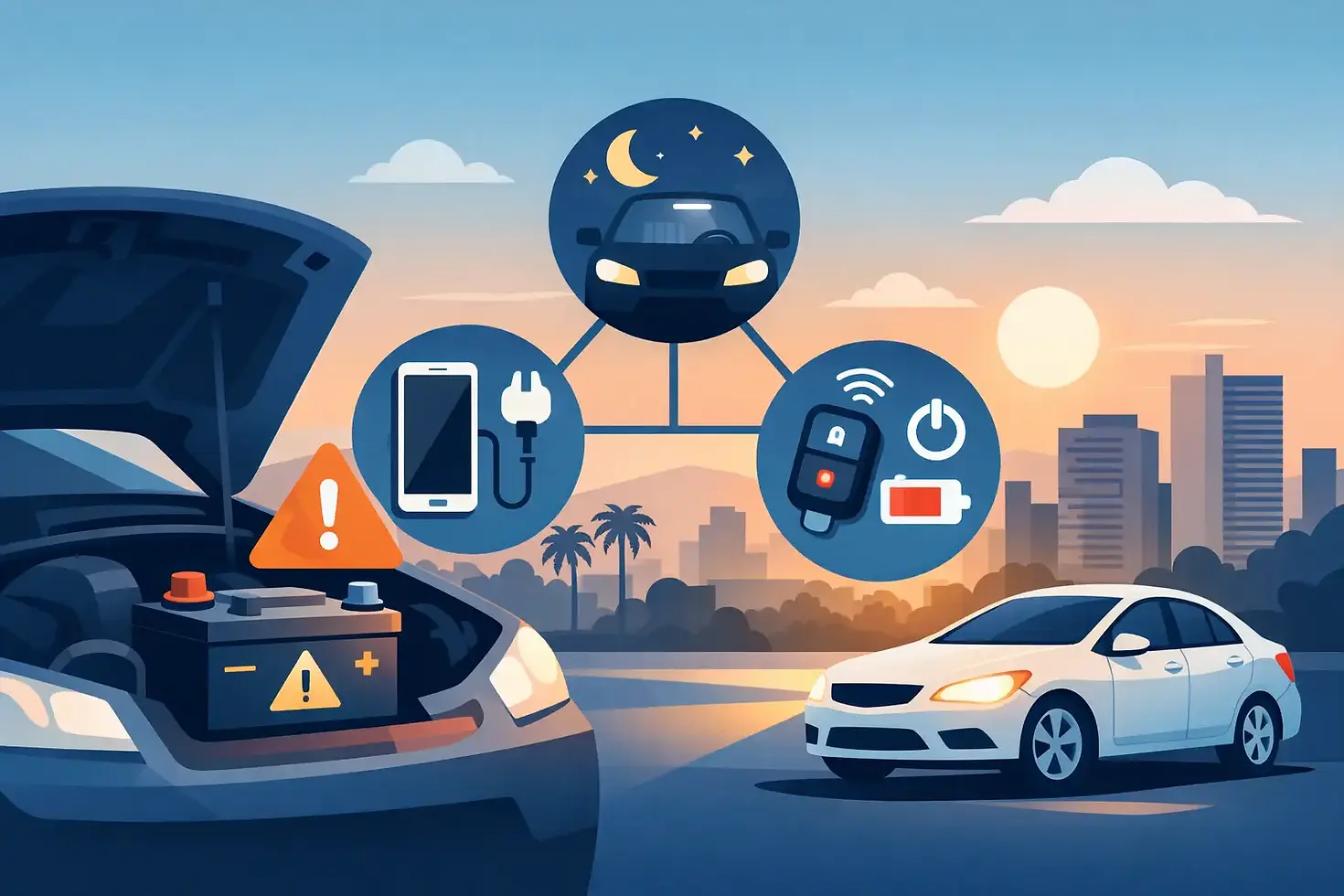
An interior light, boot light, glovebox light or parking light left on can flatten a battery faster than many drivers expect. The same applies to a dash camera, portable fridge, mobile charger, aftermarket stereo or other accessory that remains powered after the ignition is switched off.
Sometimes the issue is obvious, such as headlights left on. Other times it is less clear. A door or boot may not be fully shut, leaving a small light on where it is easy to miss. An accessory may be wired to a constant power supply rather than one that switches off with the ignition.
Before calling it a major electrical fault, check that all doors, the bonnet and the boot are closed properly. Look for lights that should be off and unplug non-essential accessories if the vehicle will be parked for a while. If the battery still loses charge, the next step is proper diagnosis rather than repeated jump-starts.
Parasitic battery drain while the car is parked
Every modern vehicle uses a small amount of power when it is switched off. The alarm, clock, central locking, security system and computer memory need a low background current. This is normal and should not flatten a healthy battery over a short period.
A parasitic drain happens when that current is higher than it should be. A faulty module may fail to go to sleep, an aftermarket accessory may keep drawing power, or a wiring issue may create a continuous drain. The vehicle can start normally after a drive, then be flat by the following morning or after sitting unused for a day or two.
Finding a parasitic drain takes more than looking under the bonnet. It usually requires electrical testing to measure the draw and narrow down the circuit causing it. Disconnecting the battery may temporarily stop the drain, but it can reset vehicle settings and will not fix the source of the problem. This is one situation where accurate testing saves time, money and frustration.
Alternator or charging-system problems
The alternator charges the battery while the engine is running. If it is not producing the correct voltage, the battery may be doing all the work until it eventually runs down. A weak alternator can make a battery look faulty, especially when the car has only just been jump-started.
Common signs include a battery warning light on the dashboard, headlights that brighten or dim with engine speed, electrical accessories behaving erratically, or a vehicle that stalls once the battery charge is depleted. A loose or worn drive belt can also affect alternator performance.
There is a trade-off here: replacing an old battery may be necessary, but replacing it without checking the charging system can leave you with the same breakdown a short time later. A voltage and alternator test helps separate a battery failure from a charging fault.
Corroded, loose or damaged battery connections
A battery can be in good condition yet fail to deliver reliable starting power if its terminals or cables are compromised. Corrosion around the terminals can restrict current flow. Loose clamps can cause an intermittent no-start, particularly after bumps or vibration. Damaged battery cables and poor earth connections can create similar symptoms.
You may notice white, blue or greenish build-up around the terminals, or find that the car starts sometimes but not always. Do not attempt to force a battery terminal into place or use makeshift repairs. Battery acid is hazardous, and a poor connection can create heat or electrical damage.
A technician can inspect the terminals, cable condition and battery mounting, then clean or repair what is required. It is a straightforward check that is often overlooked when drivers assume the battery itself is the only possible issue.
Stop-start systems and the wrong replacement battery
Vehicles with stop-start technology place greater demands on their batteries. They are designed to cope with frequent engine starts and must work closely with the vehicle's battery management system. These cars generally require an AGM or EFB battery matched to the vehicle specification, rather than a standard replacement battery chosen only by physical size.
Fitting the wrong type can lead to poor stop-start operation, warning lights, reduced battery life or repeated low-charge issues. Some vehicles also need the new battery registered or coded to the battery management system so the car can charge it correctly.
If your stop-start vehicle has a flat battery, the cheapest battery is not always the most economical answer. The right battery and correct installation can prevent a repeat call-out and protect the vehicle's electrical system.
When a flat battery is more than a one-off problem
A one-off flat battery after leaving a light on is usually easy to explain. A battery that goes flat repeatedly is a warning that something needs attention. Keep track of when it happens. Does the car struggle after sitting overnight, after short trips, only in hot weather, or even after a long drive? Those details can point towards the cause.
Avoid relying on frequent jump-starts. A jump-start gets the engine running, but it does not tell you whether the battery can hold charge, whether the alternator is working or whether the vehicle has an excessive power draw. It can also leave you stranded again at the next stop.
For Adelaide drivers, mobile battery and charging-system testing is often the quickest way to get clear answers without arranging a tow or losing a day at a workshop. 5Stars Batteries can test the battery and alternator on site, then provide the practical help needed to get you moving again.
Simple habits that help protect battery life
Use the car regularly enough to allow the battery to recharge, and take it for a longer drive occasionally if most of your travel is short suburban runs. Before locking up, check that lights are off, doors and the boot are properly closed, and accessories are not left plugged in unnecessarily.
If the vehicle will sit unused for weeks, consider a suitable battery maintainer or arrange for it to be driven periodically. The right approach depends on the vehicle and its battery type, particularly for newer stop-start cars. Most importantly, act on slow starting early. A quick test before the battery fails completely is far easier than dealing with a no-start when you are already late.


Comments